




Sun Protection for Outdoor Workers: A Complete 2026 Guide

Table of Contents
- Why Sun Protection for Outdoor Workers Can't Wait Until Lunch
- The 5-Step Sun Safety Routine That Fits a Full Shift
- Sun Protection Clothing for Outdoor Workers: What to Look For
- How Often to Reapply Sunscreen Outdoors (And Why Most Workers Get It Wrong)
- UPF Shirts for Work: Breathable Coverage That Survives the Heat
- Sun Protection for Workers Near Water: Pools, Ponds, and Spray
- Making Sun Safety Stick: What Employers and Crews Can Do
- Frequently Asked Questions
Last Updated: October 20, 2026
Why Sun Protection for Outdoor Workers Can't Wait Until Lunch
Sun protection for outdoor workers is the practice of blocking ultraviolet radiation all shift long, not just during a lunch break. It combines sunscreen, protective clothing, hats, eyewear, and shade into one routine.
The stakes are higher than most crews realize. Meanwhile, a study of outdoor workers in PubMed Central reported that 74% often or always wore sunglasses, 82% wore long-sleeved shirts, and 79% wore hats.
Those numbers look decent until you notice the gap. Hats and sleeves show up. Sunscreen doesn't.
UV damage builds quietly across a career. Every uncovered hour adds up.
The 5-Step Sun Safety Routine That Fits a Full Shift
A workable routine takes about ten minutes to set up and a few minutes per check-in. Here is the sequence we recommend.
Step |
Action |
Timing |
|---|---|---|
1 |
Check the UV index |
Before clock-in |
2 |
Cover up, then add sunscreen |
Before leaving the truck |
3 |
Set up shade |
Start of shift |
4 |
Protect eyes, head, hands |
Before first task |
5 |
Reapply on a schedule |
Every 2 hours |
Step 1: Check the UV Index Before You Clock In
The UV index tells you how strong ultraviolet radiation will be that day. Check it with the weather app before you leave. A high reading means tighter coverage and more frequent reapplication. Cloudy days still carry UV, so don't skip the check.
Step 2: Cover Up First, Then Add Sunscreen
Clothing does more reliable work than lotion. Put on long sleeves, long pants, and a hat first. Then apply broad-spectrum sunscreen with SPF 30 or higher to everything still exposed: face, neck, ears, and hands. NIOSH sun exposure guidance recommends at least SPF 30 for outdoor workers.

Step 3: Build Shade Into the Worksite
Shade is equipment, not a luxury. Set up a canopy, pop-up tent, or vehicle awning near the main work area. Schedule the toughest tasks for shadier spots. Rotate crew through shade during breaks so nobody goes hours without relief.
Step 4: Protect Eyes, Head, and Hands
UV-protective eyewear guards against long-term eye damage. A wide-brimmed hat shields the face, ears, and neck, and a hard-hat sunshade does the same on sites that require head protection. Gloves cover the hands, which burn easily and often get missed.
Step 5: Reapply on a Schedule, Not a Feeling
Set a phone alarm every two hours and reapply sunscreen when it sounds. Don't wait until skin feels hot. Sweat, rubbing, and wiping all wear sunscreen down faster than the label suggests.
Sun Protection Clothing for Outdoor Workers: What to Look For
Sun protection clothing for outdoor workers is rated by UPF, which stands for Ultraviolet Protection Factor. A UPF 50 fabric blocks about 98% of UV rays.
Here's what most buyers miss. A regular cotton tee offers roughly SPF 5 to 10, and it drops further when wet. Stretch it over your shoulders and you can see light through it. That shirt is not protection.
Priorities, in order:
- UPF rating of 30 or higher, ideally 50
- Long sleeves and long pants in lightweight fabric
- Dark or bright colors, which absorb more UV than pale ones
- Loose cut for airflow and coverage that doesn't pull tight
How Often to Reapply Sunscreen Outdoors (And Why Most Workers Get It Wrong)
Sunscreen outdoors needs reapplying every two hours, and sooner after heavy sweating, toweling off, or contact with water. Most workers get it wrong because they apply once at dawn and trust it for eight hours.
The fix is a shift-based plan rather than a vague intention. Use this schedule as a starting point and adjust for heat, sweat, and water contact.
Shift window |
What to do |
Why it matters |
|---|---|---|
Before clock-in |
Apply a broad-spectrum SPF 30+ to face, neck, ears, hands, and any exposed skin |
Gives sunscreen time to set before you start sweating |
Mid-morning check |
Reapply to face, neck, ears, and hands |
Sweat and wiping have already thinned coverage |
Before lunch |
Reapply all exposed areas |
Midday UV is typically strongest |
After lunch |
Reapply again, especially if you washed hands or splashed water |
Water and soap strip product fast |
Mid-afternoon |
Reapply to face, neck, ears, and hands |
Covers the back half of the shift |
After heavy sweat or toweling |
Reapply immediately, regardless of the clock |
Mechanical wiping removes product |
A few practical rules make the schedule stick:
- Use enough product. Most people apply far less than the label assumes. A common guideline is about one ounce for the full body, roughly a shot glass, and a nickel-sized amount for the face and neck.
- Cover the missed spots. Ears, the back of the neck, the tops of hands, and the part line in hair are the areas workers most often skip.
- Keep a second bottle within reach. A bottle locked in the truck cab does nothing when you are two fields or three floors away. Stash one in a tool bag or vest pocket.
- Pair reapplication with a water break. The alarm becomes a hydration cue too, which matters on hot days when protective clothing traps heat.
- Do not rely on the label alone. "Water-resistant" means the product holds up for a set time in testing, not for an entire shift of heavy sweat or repeated splashing.
Workers who spend part of the shift near pools, ponds, or irrigation spray should treat every splash as a reapplication trigger.
UPF Shirts for Work: Breathable Coverage That Survives the Heat
UPF shirts for work solve the biggest objection to covering up: heat. Modern UPF fabrics move moisture and dry fast, so a long-sleeve shirt can feel cooler than bare skin baking in direct sun.
Men's UPF 50+ Sun Protective Leggings - Ink →
The key is fabric choice. Look for lightweight, breathable weaves labeled for hot conditions. Quick-dry tech matters because a soaked shirt clings and loses effectiveness.
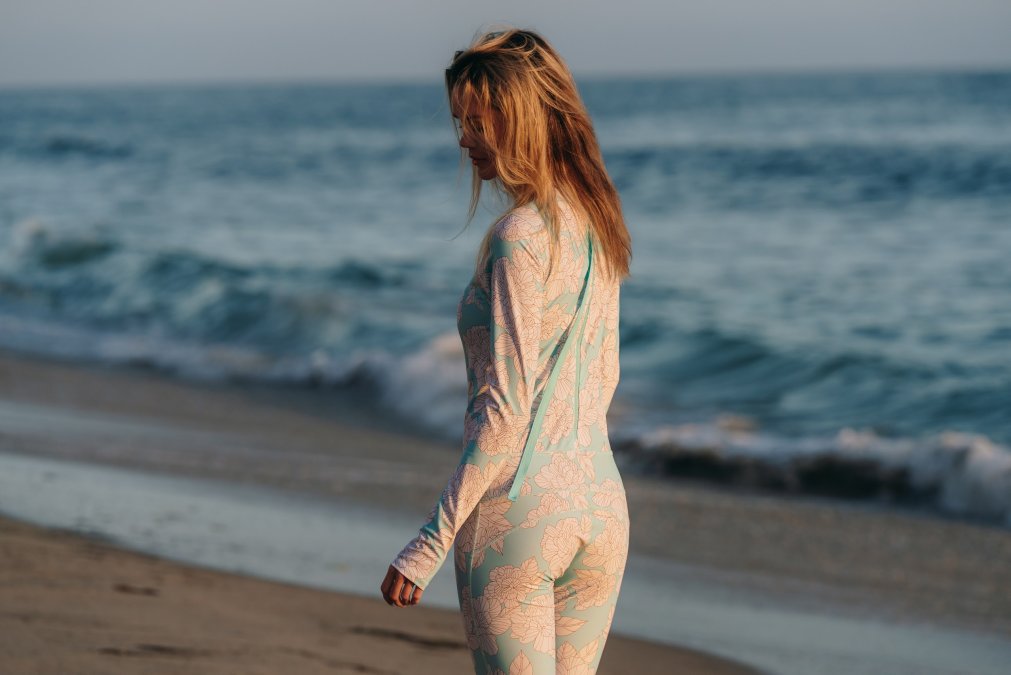
This is where TUTUBLUE's approach fits. Our UPF 50+ sun protective leggings use Quick Dry Tech and four-way stretch, and they work as a base layer under work pants or on their own for water-adjacent tasks.
Don't layer a heavy cotton shirt over a UPF base layer on hot days. Trapped heat raises your core temperature and can lead to heat stress. Breathable UPF fabric alone beats cotton stacked on cotton.
Sun Protection for Workers Near Water: Pools, Ponds, and Spray
Water changes the math. Reflective surfaces bounce UV back at you from below, and spray or splashing washes sunscreen off fast. Workers near pools, ponds, and irrigation systems need water-resistant coverage that stays put.
Standard sunscreen loses ground here. Even water-resistant formulas need reapplying after extended exposure. That's why swimwear-grade UPF apparel earns its place for anyone working in or around water.
TUTUBLUE's UPF 50+ suits block 97% of UVA and UVB rays and hold their protection through repeated wear. For crews doing irrigation, pool maintenance, or aquaculture work, a full-coverage layer means one less thing to reapply every hour.

Making Sun Safety Stick: What Employers and Crews Can Do
Sun safety programs fail when they rely on individual willpower. A Danish outdoor worker intervention study in Frontiers in Public Health tested a multicomponent approach and found that combining tools, training, and reinforcement changed worker behavior more than any single measure. The lesson is that a program needs supplies, a plan, and a check, not a memo.
Use this checklist to build and audit a program that holds up across a season.
Supplies
- Stock broad-spectrum SPF 30+ sunscreen at the worksite, not just in a first-aid kit, and refill it on a set schedule.
- Provide UPF-rated shirts and wide-brimmed hats as standard gear, sized for the crew.
- Keep UV-protective eyewear available and require it where tasks allow.
- Place shade structures, canopies, or vehicle awnings on the site plan before day one.
Planning
- Check the UV index each morning and post it at the morning briefing.
- Schedule the most exposed tasks for shadier spots or lower-UV hours when the work allows.
- Build shade and water breaks into the day, not as an afterthought.
- Set crew-wide reapplication alarms so the habit becomes normal rather than personal.
Training
- Cover sunscreen amount, missed spots, and reapplication triggers in onboarding.
- Explain why UPF clothing matters alongside sunscreen, not instead of it.
- Train supervisors to spot uncovered skin and offer a fix without singling anyone out.
Accountability
- Name a safety lead who checks the UV index and confirms supplies each morning.
- Add a short sun-safety item to the daily briefing so it stays visible.
- Review near-misses such as sunburn reports and adjust the plan.
- Check whether gear is actually worn, not just issued, and ask crews what is getting in the way.
Crews follow what leadership treats as routine. When sun protection appears in the morning briefing, in the supply order, and in the break schedule, it stops being optional.
Frequently Asked Questions
What is the best sun protection for outdoor workers?
The best approach is layered protection, not one product. NIOSH recommends sunscreen with at least SPF 30, and workplace guidance also lists protective clothing, hats, sunglasses, and shade. In practice, that means a UPF-rated long-sleeve shirt and pants, a wide-brimmed hat or hard-hat brim, UV-protective eyewear, and broad-spectrum sunscreen on exposed skin. A 2016 study found 82% of outdoor workers wore long sleeves and 79% wore hats, but only 74% often or always used sunglasses, so eye protection is the easiest gap to close.
How often should outdoor workers reapply sunscreen?
Reapply at least every two hours during continuous sun exposure, and sooner after heavy sweating, toweling off, or contact with water. A 2023 survey found 30% of outdoor workers never applied UV protection cream at work, so the bigger problem is often starting at all. Set a phone alarm for every two hours, keep a second bottle in your vehicle or toolbox, and reapply to ears, neck, hands, and the back of your knees, which are commonly missed.
Do UPF shirts actually work, and do they stay protective when wet?
Yes. UPF ratings measure how much UV radiation passes through fabric, and tightly woven, darker, or UPF-labeled fabrics block more than a standard cotton tee. Wet fabric can transmit more UV than dry fabric, which matters for workers near water. Quick-dry UPF 50+ pieces such as TUTUBLUE's men's leggings ($115.00) and full-body swimsuit ($188.00) are built for repeated water contact, and the brand states its fabric blocks 97% of UVA and UVB rays. Wash gently and skip fabric softener to help the rating last.
How can outdoor workers stay protected when working near water?
Water reflects UV radiation, so exposure climbs even when you are not swimming. Wear quick-dry UPF 50+ clothing instead of cotton, reapply broad-spectrum sunscreen more often after spray or splashes, and add UV-protective eyewear and a hat with a brim. TUTUBLUE's UPF 50+ sun-protective apparel is designed for water and outdoor recreation, which suits crews working around pools, ponds, docks, or irrigation. Build shade and rotate tasks so the most exposed work happens before 10 a.m. or after 4 p.m.
Sun exposure at work is cumulative, and the habits you build this season shape your risk for decades. If your crew works near water or you want coverage that holds up through sweat, spray, and long shifts, TUTUBLUE's UPF 50+ line is built for exactly that. Our suits block 97% of UVA and UVB rays, dry fast, and keep their protection wash after wash. Get started with TUTUBLUE and give your team coverage they'll actually wear.


Leave a comment