




Best Long Sleeve Swimsuits 2026: UPF 50+ Guide

Table of Contents
- Why Long Sleeve Swimsuits Are the Smartest Sun Protection in 2026
- UPF 50+ Swimwear for Women: What the Rating Actually Means
- How to Choose Sun Protective Swimwear That Fits Your Body and Lifestyle
- Fabric Technology: Chlorine Resistance, Salt Water, and Sustainable Materials
- Long Sleeve Swimsuit Styling Tips for Beach, Boat, and Beyond
- Design Details That Matter: Zip-Front vs. Pullover, Mock Collars, and Flatlock Seams
- Conclusion: Your Next Sun-Safe Swimsuit
- Frequently Asked Questions
Last Updated: September 15, 2026
Why Long Sleeve Swimsuits Are the Smartest Sun Protection in 2026
Best long sleeve swimsuits 2026 solve a problem sunscreen alone cannot: coverage that never washes off, sweats off, or needs reapplying every two hours. At TUTUBLUE, we built our entire collection around that idea after founder Sarah Buxton's melanoma scare, engineering UPF 50+ suits that block 97% of UVA and UVB rays. The CDC guidance on sun protection is blunt about why this matters: UV exposure is the most preventable risk factor for skin cancer, and protective clothing outperforms sunscreen for consistent coverage. Below, we break down what the UPF rating actually means, how to match fabric and fit to your body and water, and which design details separate a suit that lasts three summers from one that fades by August.
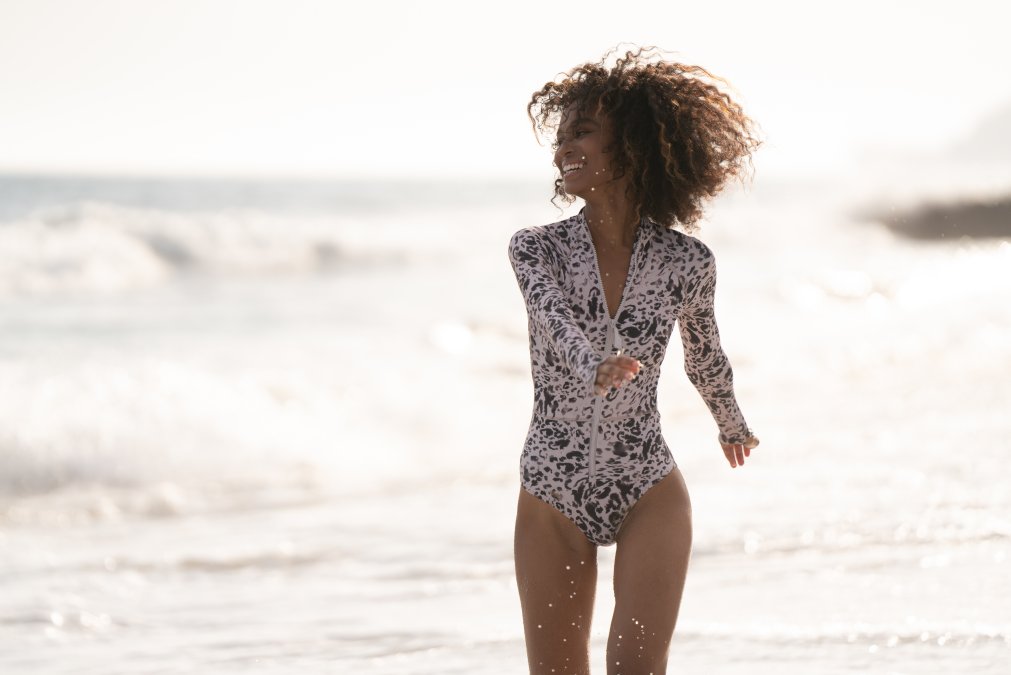
A woman in a high-neck long sleeve UPF 50+ swimsuit standing on a bright sandy beach at midday, arms relaxed, no visible sunscreen application, confident posture, harsh overhead sunlight casting short shadows
UPF 50+ Swimwear for Women: What the Rating Actually Means
UPF 50+ means the fabric blocks at least 98% of UV radiation, allowing roughly 1/50th of ambient UV to pass through (the FDA). That is a measurable, testable standard, not a marketing phrase.
The distinction that matters: UPF is a fabric rating, while SPF is a sunscreen rating. A UPF 50+ garment does not degrade with sweat or water the way lotion does. The FDA overview of sunscreen and UV protection explains that no sunscreen blocks 100% of UV, which is exactly why dermatologists recommend clothing as a first line of defense.
For women specifically, the weak points are predictable: shoulders, chest, back of the neck, and the tops of the hands. A long sleeve swimsuit covers three of those four automatically. Add a mock collar and you have closed the neck gap too.
How to Choose Sun Protective Swimwear That Fits Your Body and Lifestyle
Choosing sun protective swimwear comes down to four variables: coverage area, fabric weight, torso length, and how the suit moves with you. Get those right and the rest is preference.
Match coverage to your exposure, not your activity level. A woman who burns easily on a two-hour beach walk needs the same coverage as an open-water swimmer, even if she never gets in the water. UV exposure is cumulative across the day, so a midday walk can deliver more dose than a shaded swim.
Fit by body type, not by size chart alone. This is the advice most guides skip, and it is where returns and disappointment happen:
- Athletic or straight frames: a pullover one-piece with a raglan sleeve follows the shoulder line without gapping at the armhole. Look for a stated torso length rather than sizing up.
- Curvy or pear-shaped: a one-piece with a higher leg opening and compression through the hip keeps coverage without riding up. Two-piece long-sleeve sets let you size the top and bottom independently, which a one-piece cannot.
- Apple-shaped or mid-section coverage priority: a zip-front design lets you adjust the neckline and torso tension independently, so the suit does not pull across the middle when you raise your arms.
- Petite frames: standard long-sleeve cuts often run long in the sleeve and torso, causing fabric to bunch at the wrist and waist. A petite-specific cut or a cropped sleeve option prevents the drag that comes with excess fabric in the water.
- Tall torsos: look for suits with a stated long-torso option; a standard cut will pull at the shoulders and expose the lower back when you bend.
- Broad shoulders or full bust: raglan or set-in sleeves with four-way stretch prevent the armhole from digging, and a higher neckline with a zip lets you control chest coverage.
Test the stretch before you commit. Four-way stretch fabric recovers its shape; two-way stretch does not. A simple in-store check: stretch a section of the fabric across the grain and release it. If it snaps back flat, it will hold through a swim. If it stays slightly distorted, it will bag out when wet. If a suit feels tight across the chest but loose at the waist, it will gap when wet.
Weigh fabric thickness against water temperature. Match the weight to where you actually swim, not to a single "best" fabric.
Fabric Technology: Chlorine Resistance, Salt Water, and Sustainable Materials
Fabric technology decides how long your suit keeps its UPF rating and its shape. Two environments punish swimwear differently, and most shoppers never separate them. Understanding the fiber mechanics is the difference between a suit that lasts three summers and one that fades by August.
Chlorine is the harsher test. Chlorinated water oxidizes elastane (spandex), the fiber that gives swimwear its stretch. Each exposure breaks down a fraction of the elastane's polymer chains, so a suit that survives a saltwater summer can still go slack after a season of lap swimming. The visible signs arrive in order: the suit loses snap-back, then the color dulls, then the fabric sags at the seat and knees. Chlorine-resistant construction is engineered to hold stretch and sun protection through repeated pool use. If you swim laps more than twice a week, prioritize this over any other fabric feature.
Salt water is gentler on elasticity but harder on color. Salt does not attack elastane the way chlorine does, but salt crystals left to dry in the fabric abrade the knit and dull dyes over time. Rinse after every ocean swim in cool fresh water and saltwater suits hold up well. The rinse matters more than the soap.
Freshwater lakes add abrasion and sediment. Sand and silt work into the knit and act like sandpaper against the fibers. A tightly knit, quick-dry fabric sheds sediment better than an open knit, and it dries faster between swims.
UV degrades fibers, not just skin. Prolonged sun exposure weakens synthetic fibers over time, which is why a stated UPF 50+ rating matters even for a suit you only wear outdoors. A faded suit is often a suit whose fiber structure has already begun to break down.
Environment |
Main Threat |
What to Look For |
|---|---|---|
Chlorinated pool |
Elastane breakdown, loss of stretch |
Chlorine-resistant fabric, higher nylon-to-elastane ratio |
Salt water |
Color fading, salt crystallization |
Rinse in cool fresh water after each use |
Freshwater lake |
Sediment, abrasion |
Tightly knit, quick-dry fabric |
Sun exposure (all) |
UV degradation of fibers |
Stated UPF 50+ rating |
Sustainability angle, and the part most guides skip. Recycled nylon and recycled polyester reduce demand for virgin petroleum-based fibers, and they perform the same as conventional nylon in stretch and durability. But "recycled" is not the same as "low-impact." Synthetic swimwear sheds microfibers in the wash, and those fibers are a documented source of microplastic pollution in waterways. The practical takeaway is not to avoid synthetics, it is to buy fewer, longer-lasting suits and to wash them in a way that reduces shedding:
Long Sleeve Swimsuit Styling Tips for Beach, Boat, and Beyond
Design Details That Matter: Zip-Front vs. Pullover, Mock Collars, and Flatlock Seams
Conclusion: Your Next Sun-Safe Swimsuit
Frequently Asked Questions
Do long sleeve swimsuits provide better sun protection than sunscreen?
Yes. UPF 50+ fabric blocks 97% of UVA and UVB rays, while sunscreen requires reapplication every two hours and often misses spots. A long sleeve swimsuit offers consistent, full-coverage protection without the hassle of lotions. For extended sun exposure, swimwear with a UPF rating is more reliable than sunscreen alone.
How do I choose the right UPF rating for swimwear?
Look for UPF 50+, the highest rating available. It blocks 97% of UV rays. Lower ratings like UPF 30 block about 96%, but the difference matters for prolonged exposure. For open-water swimming, surfing, or full days outdoors, UPF 50+ with full-length sleeves and a high neck provides the best defense.
Are long sleeve swimsuits in style for 2026?
Absolutely. Long sleeve swimsuits are trending for their blend of sun safety and fashion. Modern designs feature flattering cuts, mock collars, and sustainable fabrics like recycled nylon. Brands offer zip-front and pullover styles in colors and prints that work for both athletic performance and beachwear, making them a stylish choice for any water activity.
What swimwear is most flattering for older ladies?
Long sleeve swimsuits with four-way stretch flatter. Look for high-neck or mock collar designs that elongate the torso. Darker colors and flatlock seams create a sleek look. One-piece styles with full coverage offer confidence and sun protection, while two-piece options with high-waisted bottoms also work well for mature figures.


Leave a comment